If you run a small agency, or you're a freelancer ready to productize, local business client acquisitionis the skill that separates steady revenue from feast-or-famine months. Local owners do not buy "digital marketing." They buy more calls, more bookings, and credibility in their neighborhood.
This guide is the agency version of that problem: how to choose a wedge, build lists from Google Maps, run outreach your team can repeat, and measure what matters. It works whether you are prospecting in the US, Canada, the UK, or any market where local businesses live on Maps.
For solo operators and general small-business advice, see our how to find clients for small business guide. This page goes deeper on agency structure, volume, and offers.
What local business client acquisition actually means
Local business client acquisition is not brand awareness. It is a repeatable pipeline: identify businesses that match your service, contact the decision-maker, book a short diagnostic call, and close a project or retainer. The best agencies treat it like operations, not something you only do when the bench is empty.
- List building from real operating businesses (Google Maps is the default source)
- Qualification filters (website status, ratings, category, location)
- Outbound sequences with follow-up
- A clear offer tied to one outcome
- Tracking so you can improve targeting and copy weekly
Why agencies stall on local client acquisition
Most agencies do good work for clients but treat new business as an side project. These four patterns show up constantly:
Selling everything to everyone
Generalist agencies sound safe but convert poorly. Local owners buy specialists who understand their trade and city.
Relying on referrals alone
Referrals are high-trust but unpredictable. Outbound gives you control over when the pipeline refills.
Manual list building
Copy-pasting from Maps into spreadsheets caps you at a few dozen leads per week. Agencies need volume with quality filters.
No numbers
Without tracking list size, reply rate, and meetings booked, you cannot tell whether the problem is targeting, messaging, or offer.
The fix is boring and effective: one niche, one geography per campaign, a weekly lead quota, and messaging that sounds like you looked at their Maps listing for thirty seconds.
1. Define your agency ICP and wedge offer
Enterprise ABM teams chase logos. Local agencies win by repeating the same play in one slice of the market. Write your ideal client profile in four layers:
Your wedge offer is the front door: a low-friction first yes. Examples agencies use successfully:
- Free 5-point Google Business Profile audit
- One-page "why you're invisible on Maps" teardown
- Fixed-price landing page for businesses with no website
- 90-day local SEO sprint for one service category
One sentence to align sales and delivery: "We help [category] in [city] get [one measurable outcome] using [your core service]."
2. Build the local lead engine (Google Maps first)
For local business client acquisition, Google Maps beats purchased B2B databases. Listings are fresh, categorized, and geolocated. Agencies that sell websites or SEO often start with businesses without websites or with strong reviews but weak online presence. High intent, easy to personalize.
A simple weekly list-building workflow
- Pick category + city (one campaign at a time).
- Search Maps; export or save businesses that match your trigger filters.
- Deduplicate against clients and active prospects.
- Tag each lead with one personalization hook (missing site, thin reviews, competitor gap).
Manual search works for your first fifty leads. It breaks when you need hundreds per month across reps or territories. That is where a Maps-first tool replaces the spreadsheet grind. See how to find B2B leads on Google Maps for the step-by-step, and free methods to find businesses without websites if you are bootstrapping list build.
Browse pre-built city lists on our local leads hub when you want ready-made starting points for prospecting tests.
3. Outreach at agency scale
Local owners respond to relevance, not credentials. Agency outreach should feel like a helpful neighbor noticed something on Maps, not a pitch deck attached to a mail merge.
Message rules that hold at volume
- Three to four sentences in the first touch
- One specific observation from their listing (category, area, reviews, missing website)
- One outcome, not a service laundry list
- Low-friction CTA: "Worth a 12-minute call?" or "Should I send the audit?"
- Three touches total, then archive unless they reply
Example first email
"Hi [Name], I was looking at [Business] on Google Maps. You've got solid reviews, but there's no website linked on the listing, so a lot of search traffic probably ends up on competitors. We help [category] in [city] fix that with a simple site + Maps setup. Open to a quick call this week?"
Delegation tip: assign territories (north/south metro) or categories (trades vs retail) so each rep owns personalization hooks. Automate follow-up timing; never automate the first line without a real hook.
4. Offers that close local owners
Local deals die when scope is fuzzy. Package what you sell into one of these shapes:
Starter project
Fixed price, fixed timeline: website launch, GBP cleanup, or ads setup. Best for first trust.
Monthly retainer
SEO, ads management, or content, only after a defined 30-day proof period.
Performance hybrid
Base fee plus bonus on leads or bookings. Use sparingly and define tracking up front.
Web-focused agencies: pair this with finding web design clients without Upwork or Fiverr for channel strategy beyond outbound alone.
5. Metrics and realistic targets
Agencies that improve acquisition weekly track a small scoreboard. Use these as starting benchmarks; adjust after your first 500 sends in a niche.
| Metric | Starter target |
|---|---|
| New qualified leads / week | 100–300 added to active lists |
| Outreach sent / week | 75–150 first touches (per rep or team) |
| Positive reply rate | 3–8% on well-targeted local lists |
| Meetings booked / week | 3–10 at steady state |
| Close rate (meetings → client) | 20–40% with a tight niche offer |
If reply rate is under 2%, fix targeting or first-line personalization before rewriting your entire service page. If meetings book but deals stall, fix offer clarity and proof, not top-of-funnel volume.
6. Weekly operating system (the agency pipeline)
Local business client acquisition compounds when it is calendarized. Block time for these rhythms:
Monday
Build lists for the week; assign territories or categories.
Tuesday–Thursday
Send first touches; run follow-ups; reply to responses same day.
Friday
Review metrics; kill underperforming segments; prep next week's ICP test.
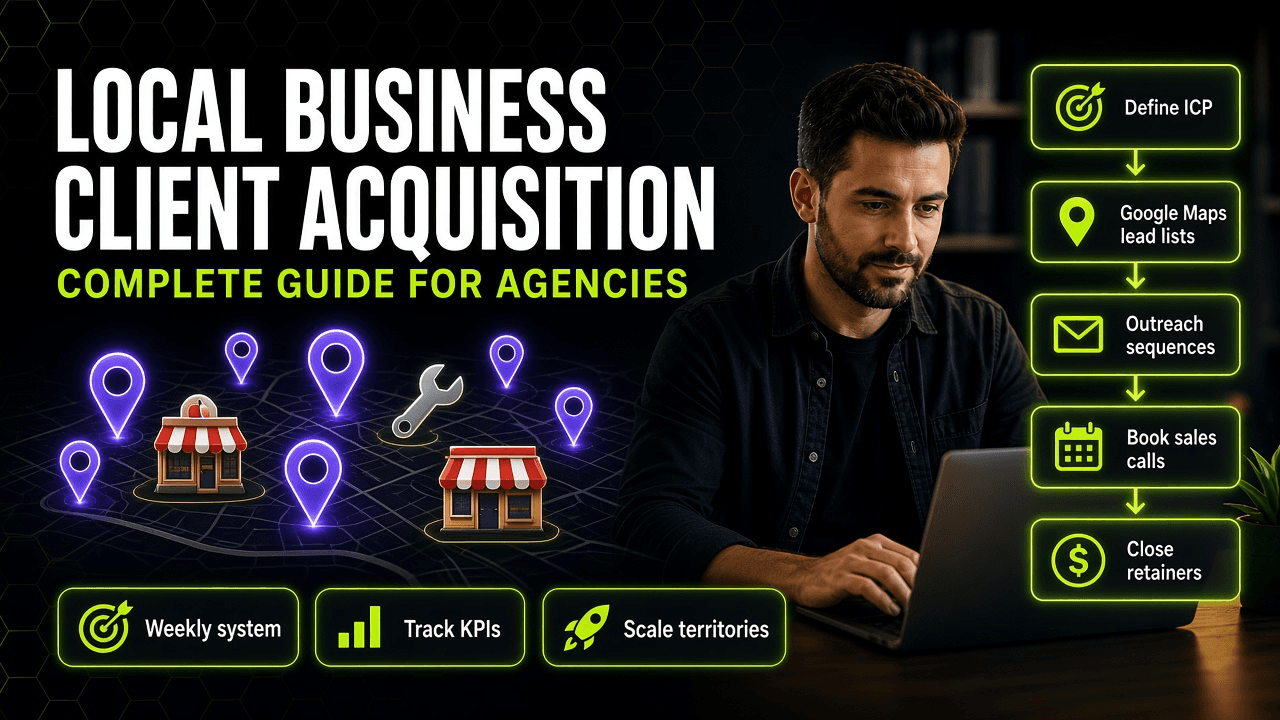
End-to-end pipeline in six steps:
Search & filter
Pull 150–300 businesses per week from Google Maps by category and city. Filter by rating and website status.
Score & shortlist
Rank by fit: trigger strength, review volume, and how easy it is to personalize outreach.
First touch
Send 3–4 sentence emails or SMS referencing something specific from their Maps listing.
Follow-up sequence
Two follow-ups, three to seven days apart. Stop after the third touch unless they engage.
Book & diagnose
15-minute call: confirm pain, show one quick win (audit snippet, mock headline, Maps gap).
Close & onboard
Simple proposal, clear scope, fast start date. Ask for referrals after delivery milestones.
Tooling: run the workflow in LeadLu
The agency bottleneck is usually list building and follow-up discipline, not strategy. LeadLu is built for Maps-first local prospecting: search by keyword and city, filter by rating and website status, save shortlists, and run email or SMS sequences from one workspace.
- Replace manual Maps copy-paste with searchable lead lists
- Prioritize businesses without websites or weak online signals
- Launch outreach the same day you build a list
- Flat pricing suited to small teams (not enterprise credit systems)
If your team compares enterprise databases, read Apollo.io alternatives for small business and LeadLu vs Apollo. For automation depth, see automated lead generation for small business.
Agency workflow: Monday list build in LeadLu → Tue–Thu sends and follow-ups → Friday metrics review. Repeat every week, same niche, until reply rates plateau, then add a second geography.
Frequently asked questions
What is local business client acquisition?
Local business client acquisition is the process of finding, contacting, and closing small businesses in a defined geography (restaurants, trades, clinics, retail, and service providers) as paying clients for your agency. It combines list building (often from Google Maps), targeted outreach, a clear offer, and follow-up until you book sales calls.
How do marketing agencies get local business clients?
Most successful agencies combine outbound prospecting with proof. They pick one niche and city, build weekly lead lists from Google Maps (often filtering businesses without websites or weak reviews), send short personalized email or SMS sequences, and lead with a specific outcome (more calls, more bookings, or a new site) backed by case studies or audit examples.
Is Google Maps good for local business client acquisition?
Yes. Google Maps is the most current directory of operating local businesses: category, location, ratings, website status, and often phone numbers. Agencies use it to find businesses that match a service wedge (for example, no website + strong reviews) instead of buying generic B2B contact lists built for enterprise sales.
How many outreach touches do local businesses need?
Plan for three to four touches over two weeks: an initial note, a follow-up with one concrete observation, a final bump, then move on. Local owners are busy; short messages that reference their business on Maps outperform long agency pitch decks.
Does local business client acquisition work in Canada and other markets?
The workflow is the same globally: define geography, search Maps by category, qualify leads, outreach locally. Compliance differs by country (email/SMS rules, consent). Adjust sending limits, language, and offer pricing for the market. Canada, the UK, Australia, and US cities all follow the same pipeline steps.
Recap: local business client acquisition for agencies
- Pick one geography and category until metrics stabilize
- Use Google Maps as your source of truth for local lists
- Lead with triggers (no website, Maps gaps, review strength)
- Keep outreach short, specific, and sequenced
- Sell wedge offers first; expand scope after trust
- Track weekly numbers and fix the weakest stage
- Systemize list build and follow-up so the pipeline runs every week
Local client acquisition is not luck. It is a process your agency can run in parallel with delivery.
Build your agency pipeline this week
Try LeadLu free
Search Google Maps by city and category, filter no-website businesses, and start outreach without juggling scrapers and spreadsheets.
Start your free trialLeadLu helps agencies and freelancers find local business leads on Google Maps and follow up with email and SMS outreach.