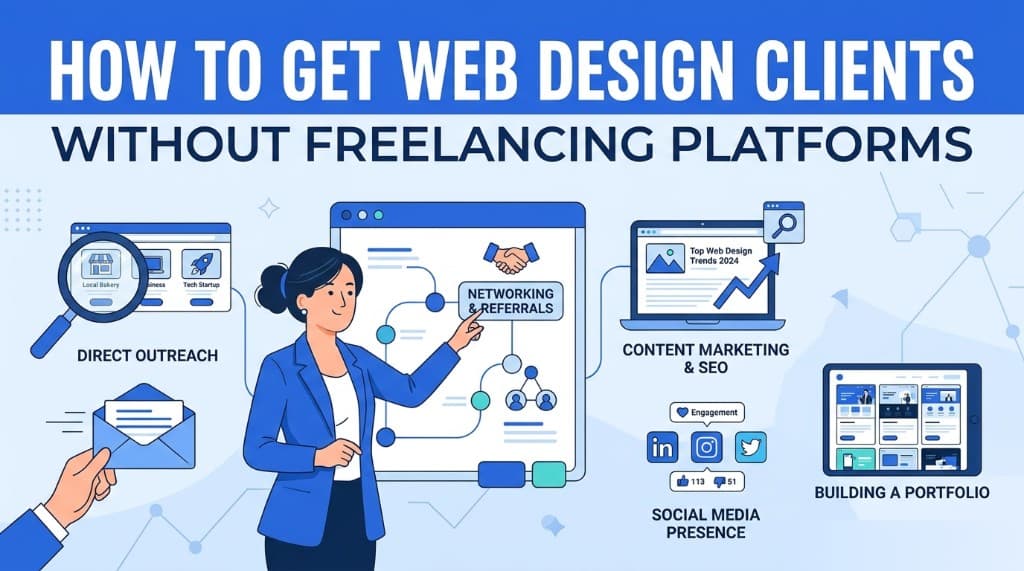
Freelancing platforms were supposed to make client acquisition easy. And they do - for a price. Between commission fees, cutthroat competition, and clients hunting for the cheapest option, many web designers find themselves trapped in a race they can't win.
The good news? The best-paid web designers rarely use platforms like Upwork or Fiverr at all. They've built direct pipelines that bring in better clients, at better rates, with far less friction.
This guide covers exactly how to get web design clients without freelancing platforms - using strategies that work in 2026, whether you're just starting out or looking to upgrade your current client base.
Strategy 01: Cold outreach to local businesses
Local businesses are arguably the most underserved web design market. Most small business owners - tradies, restaurants, medical clinics, real estate agents - either have an embarrassingly outdated website or none at all. They're not on Upwork. They're on Google Maps.
Why local outreach works so well:Local business owners trust people in their area. You're not competing against 200 profiles from around the world. You're the person who showed up. That counts for a lot.
How to find targets
Search Google Maps for a business category in your city - "plumbers Melbourne," "dentists Brisbane," "cleaning companies Sydney." Tools like LeadLu let you filter Google Maps results for businesses without websites in any city, pulling their contact details into a ready-to-use list in minutes instead of clicking through profiles one by one. Browse leads by city and category for ready-made prospecting targets in major US metros.
Look for businesses with no website, a site listed as "not secure," or one that looks like it hasn't been updated since 2015. Those are your best opportunities.
Outreach that actually gets replies
Most cold outreach fails because it's generic. The formula that converts is: specific observation + clear outcome + zero friction.
- Find their pain point. Visit their website. Note one specific, fixable problem - slow load time, no mobile version, broken contact form, no Google reviews widget.
- Lead with what you noticed."I came across [Business Name] while looking for [service] in [city]. I noticed your site doesn't load on mobile - I checked on my phone and the menu is broken."
- Offer something free. A quick Loom video walkthrough of issues, or a rough mockup of what their homepage could look like. Low commitment for them, high signal from you.
- One clear CTA."Would it be okay if I sent over a quick video?" - not "let's jump on a call" immediately.
LeadLu also handles the outreach side. Once you've got your list, set up personalised email and SMS sequences so follow-ups happen automatically instead of falling through the cracks. Most designers land their first local client within a week of running a targeted Maps campaign. If you've been using Apollo.io or similar B2B tools, see our Apollo.io alternatives comparison for why local-first prospecting works better for web design outreach.
Built for web designers
Find 50 local businesses that need a new site today
Search Google Maps by city and niche, pull contact details, and launch your first outreach sequence in under 30 minutes. Plans from $9/mo with a 1-day free trial.
Start free trialPro tip:Cold calling converts faster than email for local businesses. Most tradies don't sit at computers all day. Call, mention you spotted an issue on their site, and offer to send a short fix video. Warm the lead before the pitch.
Strategy 02: Build a referral engine
Referrals are the highest-converting source of new clients, bar none. A referred client already trusts you before the first conversation. They close faster, haggle less, and tend to refer others in turn.
The problem most designers have is they treat referrals as passive - something that happens when it happens. The fix is to turn it into a system.
Ask directly - but time it right
The best moment to ask for a referral is right after a client expresses satisfaction. Not at the end of a project when they're busy reviewing deliverables - but when they send you a message saying "This looks amazing." That's the window.
Something as simple as: "So glad you love it! If you know anyone else who needs a new website, I'd love an intro - I'm taking on two new projects this month." Specific, low-pressure, actionable.
Make referrals worth their while
Consider a structured referral incentive. A cash bonus ($100 to $200 per signed client), a discount on future work, or a free maintenance month all give clients a tangible reason to send people your way. Mention it upfront at project close - "By the way, I run a referral program…" - so it stays top of mind.
“Your happiest clients are your best unpaid salespeople. Give them a reason to sell.”
Stay in touch after projects end
Most web designers disappear after launch. A simple check-in email three months later - "Hey, just wanted to see how the site's performing, any issues?" - keeps you front of mind when someone in their network needs a designer.
Strategy 03: Content marketing and SEO
If cold outreach is hunting, content marketing is farming. It takes longer to bear fruit, but it compounds. A well-ranked blog post or YouTube video can send you inbound leads every month for years - without any ongoing effort.
What to write about
Write for your ideal clients, not other designers. Avoid posts like "10 Best Figma Plugins" - other designers will read them, not business owners. Instead, target search queries that your prospects are actually typing:
- "how much does a website cost for a small business"
- "do I need a website for my cleaning business"
- "best website for a local tradie"
- "why is my website not showing on Google"
These are questions business owners Google. If your post answers them well, you get found. If you've positioned yourself correctly, they hire you.
Repurpose across channels
One blog post can become five LinkedIn posts, three X threads, two short videos, and an email newsletter. Content marketing doesn't mean writing constantly - it means writing once and distributing broadly. The leverage is in the repurposing.
Quick win:Before writing anything new, do keyword research with free tools like Google Search Console, Ubersuggest, or even Google's autocomplete. Target keywords with clear buyer intent and low competition - often long-tail phrases in specific industries or locations.
Strategy 04: LinkedIn and X (Twitter) presence
Social media client acquisition works differently than most designers expect. The key insight is this: you're not trying to go viral. You're trying to be the most visible, credible web designer in the feed of your ideal client.
LinkedIn for B2B clients
LinkedIn is underrated for web designers targeting local businesses, startups, and established companies. The platform has a high concentration of decision-makers - operations managers, marketing directors, founders - who are actively hiring contractors.
Post content that demonstrates your expertise and results. Before/after redesigns with commentary on the decisions. "I audited 20 local business websites this week - here's what I found." Client wins with context. Results with numbers. This positions you as an authority before anyone reaches out.
X (Twitter) for the indie ecosystem
If you're targeting startups, SaaS founders, or indie hackers, X is where they live. Building in public - sharing your process, client results, lessons learned, pricing decisions - attracts exactly the kind of technically-minded founders who value good design and will pay for it.
Consistency matters more than volume. Showing up daily with useful, specific posts beats posting 10 things once then going quiet for a month.
Strategy 05: The free mockup hook
This is one of the highest-converting strategies for landing local business clients, and it's been used by web designers to build entire agencies. The concept is simple: you reach out to a business, design a free mockup of their new homepage - uninvited - and then present it to them.
The psychological shift this creates is enormous. Instead of selling a service, you're showing them their future. They're not imagining what they might get - they're looking at it. That's a fundamentally different sales conversation.
How to execute it
- Pick a target business with a clearly poor website - bad design, outdated, or non-mobile-friendly.
- Spend 1 to 2 hours designing a clean homepage mockup in Figma. Don't make it too polished - you want to show the idea, not do the project for free.
- Record a 3-minute Loom walkthrough: "Here's your current site, here's what I designed for you, here's what this would do for your business."
- Send the video via email or Instagram DM with a simple ask: "Want me to build this out?"
Yes, this takes more time than a cold email. That's exactly why it works. It signals commitment and quality that no email template can replicate. A 20 to 30% conversion rate on free mockups is not uncommon when done well.
Pair this with LeadLuto build your target list fast: search "restaurants in [city]" or "dental clinics [suburb]" on Google Maps, filter for businesses with weak websites, then send your mockup pitch to a qualified shortlist instead of guessing.
Strategy 06: Agency partnerships and white-label work
Marketing agencies, branding studios, and PR firms need web design work constantly - and most don't have in-house developers. Becoming a trusted subcontractor for an agency can be a steady, high-quality stream of work without ever doing your own prospecting.
The relationship works both ways. Agencies get reliable execution without a full-time hire. You get consistent, pre-sold projects without a sales cycle. It's one of the most efficient client channels available.
How to get in
Research digital marketing agencies in your city or in your niche. Look at their service pages - do they offer web design? If their portfolio looks light on recent work, or if they list it as a service but don't showcase it prominently, they may be outsourcing or struggling to deliver it. Reach out as a partner, not a vendor: "I specialise in [niche] web builds. I work white-label with a few agencies. Worth a quick chat?"
Note on pricing: White-label work typically pays slightly less than direct client work - but with zero sales time, no client management overhead, and consistent volume, the effective hourly rate can actually be higher. Price yourself at a level that gives the agency room to mark up profitably.
Strategy 07: Niche down to stand out
The single most effective thing you can do to command higher rates and get inbound clients is to specialise. "Web designer" is a commodity. "Web designer for physiotherapy clinics" is a specialist. One of those people gets hired immediately. The other competes on price.
Niching works because it changes your positioning from "I can build your website" to "I understand your business." When a dentist visits your site and sees a portfolio full of dental clinic websites, testimonials from dentists, and a headline that speaks directly to their growth problems - the sale is nearly done before the conversation starts.
How to pick your niche
Start with industries you already know: previous jobs, family businesses, existing clients. Alternatively, look for sectors with consistent need and healthy margins: legal, medical, trades, real estate, hospitality, professional services. Pick one, go deep, and build a portfolio in that space. You'll be shocked how fast inbound inquiries follow.
Once you pick a niche, use Google Maps prospecting to build a list of every business in that category in your target city. LeadLu lets you save those searches as Lead Campaigns that auto-refresh, so your pipeline of prospects stays full while you focus on design work.
Strategy 08: Online communities and forums
Facebook Groups, Reddit communities, Slack workspaces, and Discord servers are full of business owners asking for web design help - often with budget ready to go. The catch is that you have to be a contributing member before you pitch.
The approach: join communities where your ideal clients hang out (not web design communities - business owner communities). Spend 30 days genuinely helping people - answer questions, give feedback, share useful resources. Build credibility. Then, when someone asks "anyone know a good web designer?" your name comes up because you're already known and trusted in the group.
This strategy works particularly well in niche communities. A Facebook group for Australian cleaning business owners, a Slack for startup founders, a subreddit for real estate investors - these hyper-targeted communities have members who are primed to spend.
FAQ
How long does it take to get clients without platforms?
Cold outreach can produce results within days if executed well. Content marketing and SEO typically take 3 to 6 months to generate consistent inbound. Referrals and community-building fall somewhere in between. Most designers combine 2 to 3 strategies simultaneously for the best results.
Can I do this with no portfolio?
Yes - but you need to bridge the trust gap. Offer a deeply discounted or free first project for a local business in exchange for a testimonial and portfolio rights. One real result beats ten spec projects. Alternatively, the free mockup strategy works well here: you're showing skill before asking for money.
Is cold email spam?
Generic cold email sent in bulk is spam. Personalised, researched outreach to relevant businesses with a genuine observation and offer is professional business development - the same thing every B2B sales team does. The difference is specificity. One personalised email beats 100 template blasts every time.
What should I charge without platform pricing pressure?
Price based on value, not hours. A website that generates $50,000 in leads for a local business is worth more than $1,500 - even if it took you 20 hours to build. Research what outcomes your clients care about, quantify the impact of a well-built website for their business, and price relative to that. Direct clients, especially local businesses, will often pay 3 to 5x what a platform client would - because they're buying a relationship, not a commodity.
What's the fastest strategy for a first client?
Cold outreach with a free mockup to a local business. It's the highest-effort strategy, but it's also the fastest to convert when done right. Pick a business with an obviously poor website, spend 90 minutes on a mockup, send a personalised Loom video, and follow up once. Repeat until you land the first one - then let the referral engine start running.
How do I get web design clients without freelance platforms?
The most reliable path is direct outreach to local businesses - the ones that aren't on Upwork because they've never heard of it. Search Google Maps by niche and city, identify businesses with no website or a broken one, and reach out with a personalised observation. Pair that with a referral system and some niche positioning, and you'll have more direct leads than a platform ever provided. Tools like LeadLu automate the prospecting side so you only spend time on outreach and closing.
How do I find clients as a freelance web designer?
Start local. Most cities have hundreds of businesses with no web presence - restaurants, tradies, clinics, law firms - who have never posted on a freelancing platform. Cold outreach with a free mockup is the fastest way in. After the first few clients, referrals take over. For longer-term inbound, LinkedIn and niche content marketing attract decision-makers who are already looking. The common thread: every method works better when you're reaching out to a pre-qualified list rather than guessing.
The bottom line
Getting web design clients without freelancing platforms isn't harder than using them - it's different. And for most designers who make the switch, it's dramatically better. Here's what to start with:
Ready to land your next web design client?
Stop competing on Upwork. Find local businesses on Google Maps, send personalised outreach, and follow up on autopilot with LeadLu.
Start your 1-day free trial- Cold outreach + free mockups for immediate pipeline. Use LeadLu to skip manual prospecting and get straight to outreach
- Referral system to turn current clients into salespeople
- Niche positioning to attract inbound without competing on price
- Content marketing for long-term compounding inbound
- LinkedIn or X presence to stay visible to your ideal market
- Agency partnerships for reliable, low-overhead volume
- Community engagement for trust-first warm leads