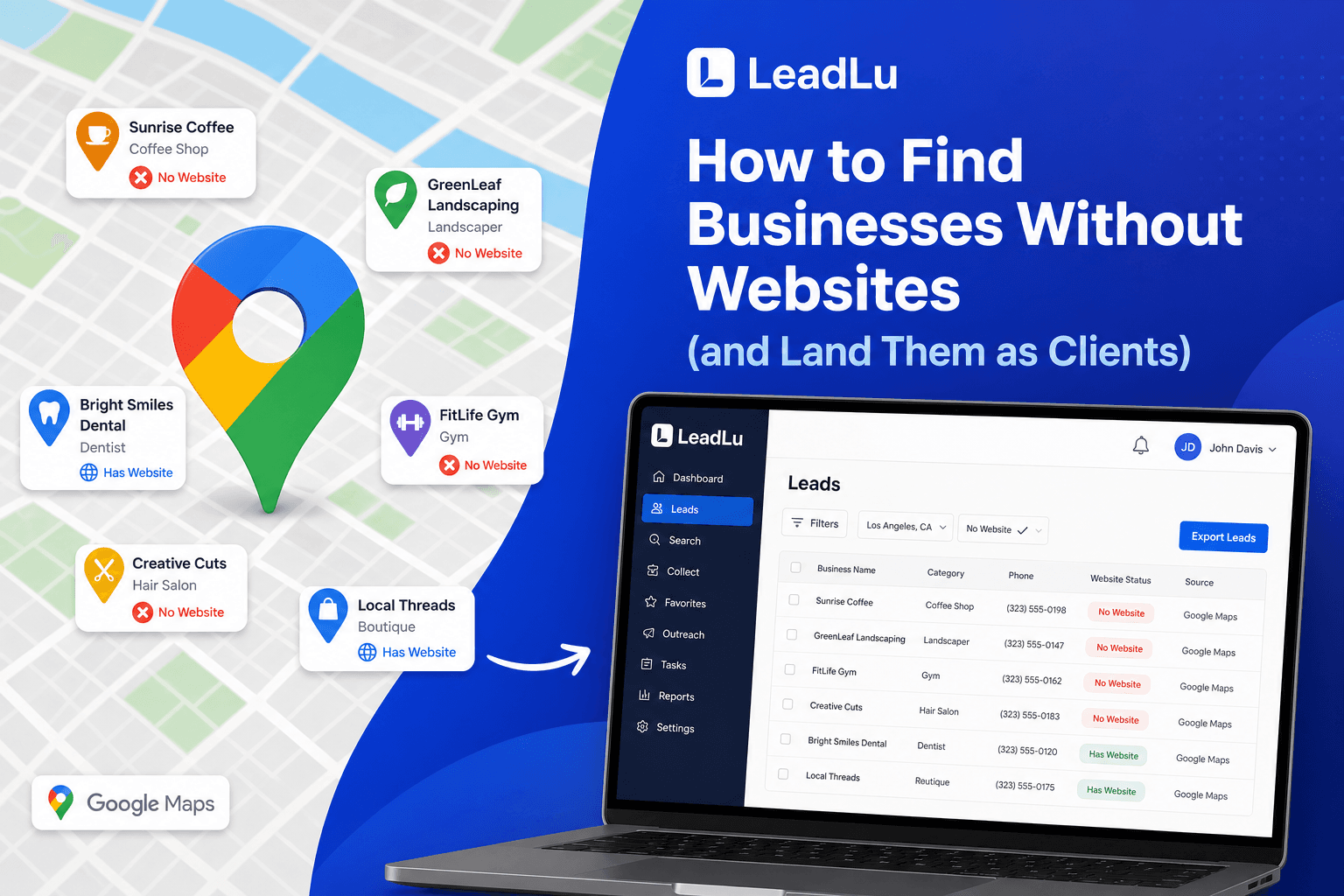
If you sell web design, digital marketing, SEO, or any service that helps businesses get found online, businesses without websites are your highest-intent prospects. They already have the problem. They just have not found the solution yet. For a complete client acquisition playbook, see our guide on finding web design clients without Upwork or Fiverr. Browse local leads by city to start prospecting in a specific market.
This guide covers everything: how many businesses have no website, which industries to focus on, exactly how to find them, and the outreach sequence that converts them into paying clients.
How Many Businesses Have No Website?
The numbers are larger than most people expect. According to research by Clutch, Statista, and BrightLocal:
of small businesses in the US have no website (Clutch, 2024)
of UK small businesses still operate without a website
of consumers research a business online before visiting in person
Put another way: millions of active, revenue-generating businesses are invisible to customers searching online. For anyone selling web services, this is not a niche opportunity. It is one of the largest addressable markets in local B2B.
Why it matters for you:A business without a website is not a cold lead. They are a warm prospect with a known, urgent problem. The objection is not "do I need one" but "who do I trust to build it and how much does it cost?" Your job is to answer both questions before a competitor does.
Why Do So Many Businesses Still Have No Website?
Understanding why businesses have no website makes your outreach dramatically more effective. The reasons fall into a few predictable patterns:
They think it is too expensive
Many small business owners have been quoted $3,000 to $10,000 for a website by agencies and assumed it was out of reach. They have never been shown a realistic, affordable option.
They rely on word of mouth
Older businesses in particular have built their client base entirely on referrals. They are not convinced a website would add value, mostly because nobody has shown them the numbers.
They do not know how to set one up
For a 55-year-old plumber running a one-person operation, building a website feels technical and overwhelming. The barrier is not money. It is knowledge and time.
They are relying on social media or Google Maps alone
Some businesses have a Facebook page or an active Google Maps listing and assume that is enough. In many cases, it is not, especially for customers who want to see services, pricing, or trust signals before calling.
Each of these is an opening for you. If you know why they do not have a website, you know exactly what objection to address in your outreach.
Which Industries Have the Most Businesses Without Websites?
Not all industries are equal when it comes to website adoption. Target the categories where the gap is widest and the need is clearest.
| Industry | Examples | Est. no-website rate |
|---|---|---|
| Tradespeople | Plumbers, electricians, painters, tilers | ~40% |
| Cleaning services | House cleaners, commercial cleaners, carpet cleaners | ~38% |
| Landscaping | Gardeners, lawn care, tree services | ~35% |
| Food and hospitality | Food trucks, cafes, local restaurants | ~30% |
| Beauty and personal care | Nail salons, barbers, mobile beauticians | ~32% |
| Local retail | Boutiques, gift shops, specialist stores | ~28% |
| Health and fitness | Personal trainers, small gyms, yoga studios | ~25% |
These industries share two common traits: the owners are typically busy doing physical work (not sitting at computers), and customers actively search online before booking. That gap between search behaviour and business visibility is your opportunity.
How to Find Businesses Without Websites
There are several ways to find businesses without websites. The right method depends on whether you want to prospect manually or scale the process:
Google Maps manual search
Search for a business category in your city ("plumbers Sydney" or "nail salons Austin"). Scroll through the results. Any listing without a website link shows "No website" or simply has no URL. This works but takes time at scale.
LeadLu automated filterRecommended
LeadLu lets you search Google Maps by category and location and filter specifically for businesses without a website. Instead of clicking through hundreds of listings manually, you get a clean, exportable list of no-website businesses with their contact details in minutes.
Local Facebook groups
Business owner groups on Facebook often have members promoting their services with no website link in sight. Search groups like "Small Business Owners [City]" or "[Industry] Professionals [Region]".
Nextdoor and local directories
Nextdoor, Yelp, and local trade directories regularly feature businesses with no accompanying website. Any business that only lists a phone number is a potential prospect.
Pro tip:When prospecting by city, start with a specific neighbourhood or suburb rather than the entire metro area. Hyperlocal targeting makes your outreach feel personal ("I was looking at businesses in [neighbourhood]") and improves reply rates significantly.
How to Approach Businesses Without Websites
The biggest mistake people make when reaching out to businesses without websites is leading with their service. Leading with the business owner's problem converts much better.
What not to say
"Hi, I build websites for local businesses. I offer affordable packages starting from $X. Let me know if you are interested."
This gets ignored. It is generic, self-focused, and gives the recipient no reason to reply.
What to say instead
Frame the message around what they are losing, not what you are selling. Reference something specific about their business. Keep it to three or four sentences. One clear call to action.
Example email
"Hi [Name], I came across [Business Name] on Google Maps while looking for [service] in [city]. You came up in the results, but there was no website link, which means anyone who finds you and wants to learn more before calling has nowhere to go.
I put together a quick mockup of what a homepage for [Business Name] could look like. Would it be useful if I sent it over?"
This works because it references something real, explains the cost of the problem, and asks a yes/no question that is easy to answer. There is no hard sell, no price drop, and no pitch decks attached.
5-Step Outreach Sequence for Businesses Without Websites
Single-touch outreach rarely converts. Most responses come from the second or third touchpoint. Here is the sequence that works:
Lead with the problem, not your service
Do not open with "I build websites." Open with what they are losing. "I searched for plumbers in [city] and your Google Maps listing came up, but there was no website. A lot of potential customers click away when they can not find more information." That lands differently.
Show, do not tell
Record a 90-second Loom video showing their Google Maps listing, what a customer searching for their service sees, and a quick mockup of what their homepage could look like. Showing beats telling every time.
Make the ask easy
Do not ask for a call on the first contact. Ask: "Would it be useful if I sent over what this could look like for your business?" A yes/no question removes friction and starts the conversation.
Follow up
Most responses come on the second or third touchpoint. Set up a short sequence: Day 1 intro, Day 4 follow-up, Day 10 final check-in. LeadLu automates this so no lead falls through the cracks.
Use SMS for trades and local services
Plumbers, electricians, and gardeners are rarely at a desk. A short, personal SMS often outperforms email for trade industries. Keep it under 3 sentences and reference their business by name.
How to Scale This with LeadLu
Finding 10 businesses without websites manually on Google Maps takes about an hour. Building a list of 200 takes most of a day. At that rate, consistent prospecting becomes unsustainable alongside actual client work.
LeadLu is built specifically for this workflow. Search by business category and city, filter for businesses without a website, and get a clean list with names, phone numbers, emails, and review counts in minutes. If you have been using Apollo.io or similar B2B databases, our Apollo.io alternatives comparison explains why Google Maps prospecting works better for local no-website leads.
Find no-website businesses
Search Google Maps by category and location. Filter for listings with no website in seconds.
Automated email sequences
Set up personalised outreach with Day 1, Day 4, and Day 10 follow-ups. LeadLu sends them automatically.
SMS for trade industries
Reach plumbers, electricians, and cleaners by SMS. Higher open rates for businesses that are rarely at a desk.
You can also set up a Lead Campaign in LeadLu. Save your search ("plumbers in Austin, no website") and LeadLu auto-refreshes it on a schedule, emailing you new no-website businesses as they appear. Your pipeline stays full without manual re-searching.
Plans start at $9/mo. There is a 1-day free trial on all plans with no credit card required.
Find 50 businesses without websites today
Search Google Maps by category and city. Filter for no-website listings. Launch your outreach sequence. All from one workspace, starting at $9/mo.
Start 1-day free trial- No credit card required
- 2-minute setup
- Plans from $9/mo
Frequently Asked Questions
How many businesses do not have a website?
Studies consistently show that 27 to 36% of small businesses in the US and UK operate without a website. In trade-heavy industries like plumbing, landscaping, and cleaning, the rate is often higher, approaching 40%.
How do I find local businesses without websites?
The fastest method is Google Maps. Search for a business category in your target city and look for listings with no website link. Tools like LeadLu automate this by letting you filter Google Maps results for businesses without websites, returning a ready-to-contact list in minutes.
What should I say when contacting a business without a website?
Lead with the opportunity cost: customers are searching for them online and not finding them. Keep it short, reference something specific about their business, and avoid a hard sell on the first contact. Offer a mockup or a free audit to reduce friction and start the conversation.
What industries have the most businesses without websites?
Tradespeople (plumbers, electricians, painters), cleaning services, landscaping, food trucks, local retailers, nail salons, and independent gyms consistently have the highest rates. These industries also have customers who actively search Google before booking, making the website gap especially costly.
Is cold outreach to businesses without websites legal?
Yes. Outreach to business email addresses is legal under CAN-SPAM (US), CASL (Canada), and equivalent regulations in most countries, provided you include an unsubscribe option and do not misrepresent yourself.
The Bottom Line
Businesses without websites are not a niche market. They are tens of millions of active, paying businesses that have a clear, solvable problem and have simply not been shown the solution yet. Google Maps is your database. The right outreach sequence is your conversion tool.
If you build websites, run outreach campaigns, or sell any digital service to local businesses, this is one of the most reliable ways to build a consistent client pipeline. Start with one city, one industry, and a short email sequence. Scale from there.