You started your business. You're good at what you do. But the clients aren't exactly lining up.
Sound familiar?
Finding clients is the one challenge that never fully goes away, whether you're brand new or three years in. The market is noisier, buyers are more skeptical, and the old tactics (post on social, hope for referrals, repeat) just don't cut it anymore.
This guide covers exactly how to find clients in 2026: what actually works, what's a waste of time, and how to build a system that fills your pipeline consistently. No fluff. Let's get into it.
Why Most Small Businesses Struggle to Find Clients
Before tactics, let's get honest about why client acquisition is hard for most small businesses.
They're entirely passive
They post content, set up a website, list themselves on Google, and wait. Passive marketing can work, but it's slow, unpredictable, and gives you zero control over when leads come in.
They rely on one channel
Word of mouth is great until it dries up. Referrals are wonderful until a couple of good clients churn. A business that depends on one source of new clients is one bad month away from a pipeline crisis.
They treat outreach as uncomfortable
Cold outreach has a bad reputation, mostly because it's done badly. Spray-and-pray emails to strangers with zero personalisation deserve to be ignored. But targeted, relevant outreach to the right people? That converts.
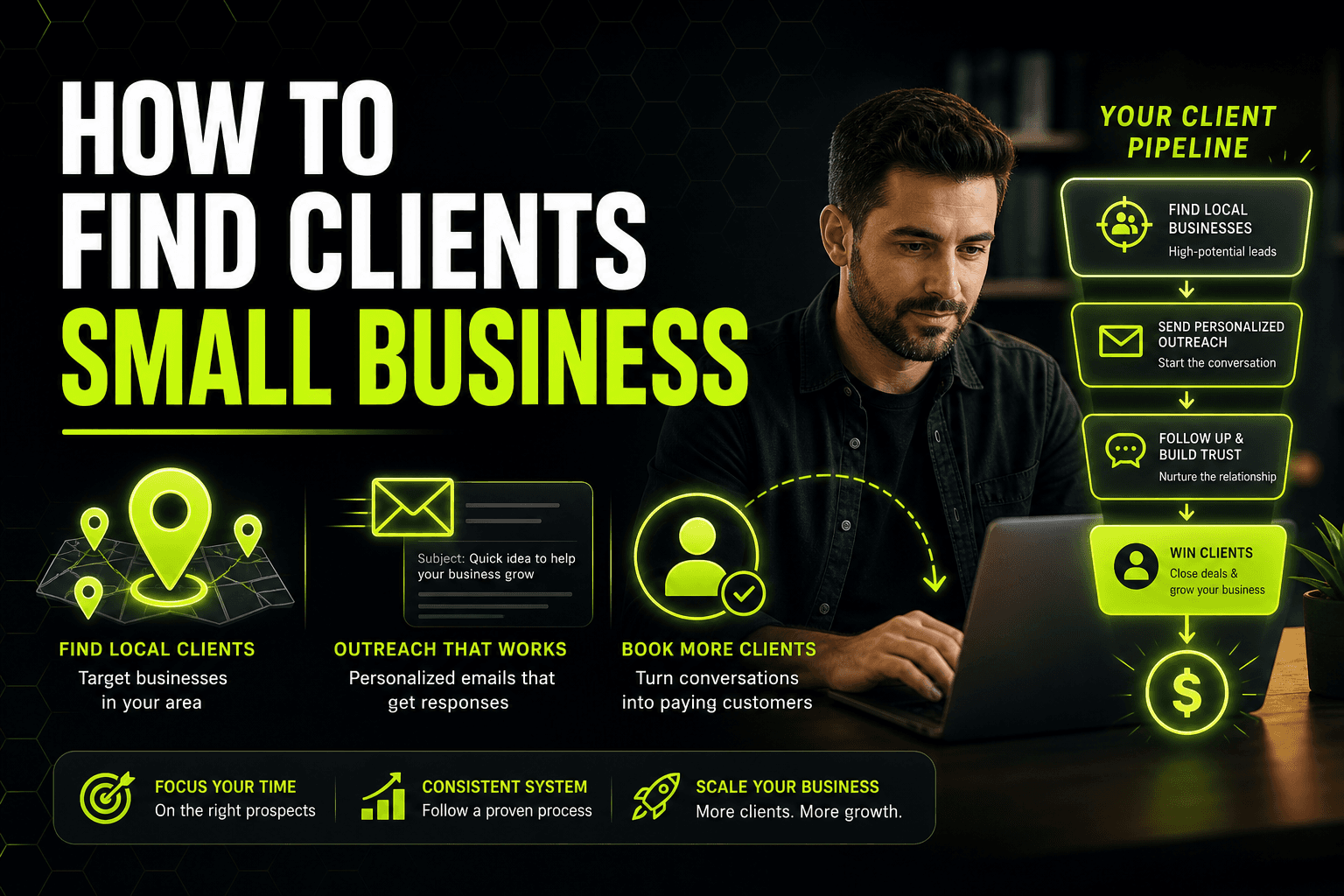
The businesses that find clients consistently do three things: they go outbound, they use multiple channels, and they have a repeatable process. Here's how to build that.
1. Get Clear on Who Your Ideal Client Actually Is
This sounds obvious. Most people skip it anyway. Before you can find clients, you need to know exactly who you're looking for. Not "small business owners." That's 2 million people. Be specific:
- What industry are they in?
- What city or region?
- What size business?
- What problem do they have that you solve?
The more specific your target, the easier every step that follows becomes. Your outreach is more relevant. Your messaging lands better. Your close rate goes up.
A plumber targeting "commercial property managers in Melbourne with 5+ properties" will outperform one targeting "anyone who needs plumbing" every single time.
Write it down. One sentence: "My ideal client is [who] in [where] who struggles with [problem]."
2. Cold Outreach: The Most Reliable Way to Find Clients Fast
If you need clients now, cold outreach is your fastest path. Waiting for SEO to kick in takes months. Ads cost money with no guaranteed return. Referrals are passive. Cold outreach is something you can start today and get replies this week.
The key is doing it right.
Find the right prospects first
You can't send great outreach to a bad list. Before you write a single email, you need a targeted list of people or businesses who fit your ideal client profile.
For local business owners, the best place to find this? Google Maps. It's the world's most up-to-date directory of local businesses, with names, categories, locations, websites, and contact info. Tools like LeadLu let you search Google Maps by business category and location in minutes, giving you a targeted lead list without hours of manual research.
Write outreach that doesn't feel like outreach
The reason cold email gets a bad reputation is that most of it is terrible. Generic, self-focused, obviously mass-sent. Good outreach is:
"Hey [Name], I help [type of business] in [location] with [specific problem]. I noticed [something specific about them]. Would it be worth a quick chat to see if I can help?"
Follow up. Seriously.
Most replies don't come from the first email. They come from follow-up two or follow-up three. Set up a simple sequence: first touch, follow-up three days later, final follow-up a week after that. Three touchpoints, all relevant, all short. Then move on.
3. Use Google Maps to Find Local Clients
If your clients are local businesses (tradespeople, restaurants, clinics, retail stores, service providers), Google Maps is one of the most underrated client acquisition tools available.
Every local business on Google Maps is operating and active, serving a specific area, categorised by type, and often missing exactly what you offer.
- A web designer could search "restaurants in Brisbane" and have 200 warm prospects in an hour
- A marketing agency could pull every dental clinic in Sydney
- A bookkeeper could find every trades business in Perth that probably hates doing their own accounts
The leads are right there. Most people just don't think to look. LeadLu automates this entire process: search by category and location, pull a clean list of local business leads with contact details, and launch your outreach campaign in the same workflow. For the full step-by-step, read our Google Maps lead generation guide. Web designers should also see our post on finding clients without Upwork or Fiverr.
4. LinkedIn for B2B Clients
If your ideal client is a business professional (a marketing manager, an ops director, a founder), LinkedIn is where they live. The most effective approach isn't ads or posting and hoping. It's direct outreach.
- Connect with decision-makers in your target niche
- Send a short, specific connection request (not a pitch)
- Once connected, lead with value. Share something useful before you ask for anything
- Then make a simple, low-pressure ask
LinkedIn outreach takes more time per lead than email, but the conversation quality is often higher. Use it as a complement to email outreach, not a replacement.
5. Referrals: Turn One Client Into Many
Referrals are the best leads you'll ever get: higher trust, faster to close, more likely to stick around. But most businesses leave them entirely to chance. Don't wait for clients to mention you organically. Build a process:
- After a successful project, ask directly: "Do you know anyone else who might benefit from what we did here?"
- Offer an incentive: a discount on their next invoice, a small finder's fee, a gift
- Make it easy: give them a short paragraph they can copy-paste to send to someone
One happy client, reached at the right moment, can send you three more. That compounds fast.
6. Content That Attracts Inbound Leads
Cold outreach fills your pipeline now. Content fills it six months from now. Writing about the problems your ideal clients have builds trust and authority over time. When someone Googles their problem and finds your post, they arrive already warmed up.
You don't need to be a prolific content creator. One good piece of content per week, consistently, is enough to build a real inbound channel over 6–12 months.
The best content answers questions your clients are already asking. Not "what we do" content. Problem-focused, genuinely useful content that makes them think "this person gets it."
7. Build a Simple Outreach System (So It Runs Without You)
The difference between businesses that find clients consistently and those that scramble is systems. Here's a basic system that works:
Build your list
Pull 100–200 targeted prospects per week from Google Maps, LinkedIn, or your target industry. Use LeadLu for local business leads to make this fast.
Send outreach
Email sequences with 2–3 touchpoints, personalised to the niche. Automate the follow-ups.
Qualify responses
Reply personally to anyone who responds. Book a call if they're a fit.
Close and deliver
Do great work. Ask for referrals at the end.
Repeat
Every week, not just when the pipeline runs dry.
The businesses that always have clients aren't luckier than you. They're more consistent. A small amount of outreach every single week compounds into a full calendar over time.
The Tool That Makes This Easier
Manual prospecting is the bottleneck for most small businesses doing outreach. Building lead lists is tedious, time-consuming, and usually means hours of copy-pasting from Google into a spreadsheet.
LeadLu cuts that work down to minutes. Search any business category in any location, pull a clean list of leads from Google Maps complete with contact details, and launch automated email and SMS sequences, all in one place. No complex setup. No credit system to navigate. If you are comparing it against Apollo.io, see our Apollo.io alternatives comparison with full pricing.
If your ideal clients are local businesses, there's no faster way to go from "I need clients" to "I have outreach running" than LeadLu.
Quick Recap: How to Find Clients
- Get specific about who your ideal client is before doing anything else
- Go outbound. Don't wait for clients to find you
- Use Google Maps to build targeted local lead lists fast
- Write short, relevant outreach and always follow up
- Leverage LinkedIn for B2B professional clients
- Build a referral process. Don't leave it to chance
- Create content to build an inbound channel over time
- Systematise everything so outreach happens weekly, not just in panic mode
Finding clients isn't a mystery. It's a process. Build the process, work it consistently, and the pipeline takes care of itself.
Ready to start finding local clients today?
Try LeadLu free
Find local leads on Google Maps and follow up automatically with personalised email and SMS outreach. No complex setup. No credit system.
Find your first leads in minutesLeadLu helps small businesses find local leads on Google Maps and follow up automatically with personalised email and SMS outreach.